Deepfake Job Candidates: How Scammers Fake Their Way Into Companies
Deepfake job candidates are using AI to pass video interviews and infiltrate companies. Learn how the deepfake job interview scam works, the red flags to spot, and how to protect your hiring process in 2026.
· By Truvizy Research Team · 8 min read
TL;DR
Criminals are using deepfake technology and stolen identities to pass remote job interviews, get hired into legitimate companies, and then steal data, install malware, or funnel paychecks overseas. The FBI issued warnings as early as 2022, and the threat has intensified with more accessible AI tools in 2026. Verifying candidates through live background checks and in-person secondary interviews is now essential.
Your HR team just finished a promising Zoom interview for a senior software engineer role. The candidate was articulate, technically sharp, and their resume checked out perfectly. You extend an offer. Three weeks into employment, your security team flags unusual data exfiltration activity from their account. A forensic audit reveals the "employee" was never who they claimed to be, they used an AI-generated face overlay during every video call, a stolen identity, and forged documents to get hired. Your company's codebase, client data, and internal systems have been quietly plundered. This is the deepfake job candidate scam, and it is happening right now to companies across every industry.
What Is the Deepfake Job Candidate Scam?
The deepfake job candidate scam is a form of identity-enabled hiring fraud in which criminals use real-time AI face-swapping tools to impersonate a legitimate person, or a completely fabricated identity, during remote video job interviews. The FBI issued its first formal advisory on this threat in June 2022, warning employers that reports of deepfake candidates applying for remote technology positions had increased significantly. By 2025, the tactic had become a mainstream fraud method, not a niche curiosity.
These fraudsters do not just want the paycheck. Many are part of organized criminal networks, including, according to the U.S. Department of Justice, North Korean state-sponsored IT workers who infiltrate American companies to generate hard currency for weapons programs and to conduct espionage. Others are financially motivated criminals who monetize stolen credentials, data, and system access on dark web markets.
The scam is made possible by three converging factors: the normalization of fully remote hiring without in-person verification, the commercial availability of real-time face-swapping software that costs less than $30 per month, and a global supply of stolen personal identities that fraudsters use as the underlying fake persona.
How Deepfake Job Interview Scams Work
The attack begins weeks or months before any interview. The fraudster acquires a stolen identity, a real person's name, resume history, educational credentials, and sometimes even their LinkedIn profile, which they clone or impersonate. They may pay for professional resume writing services and fill gaps with fabricated references backed by disposable phone numbers and email addresses.
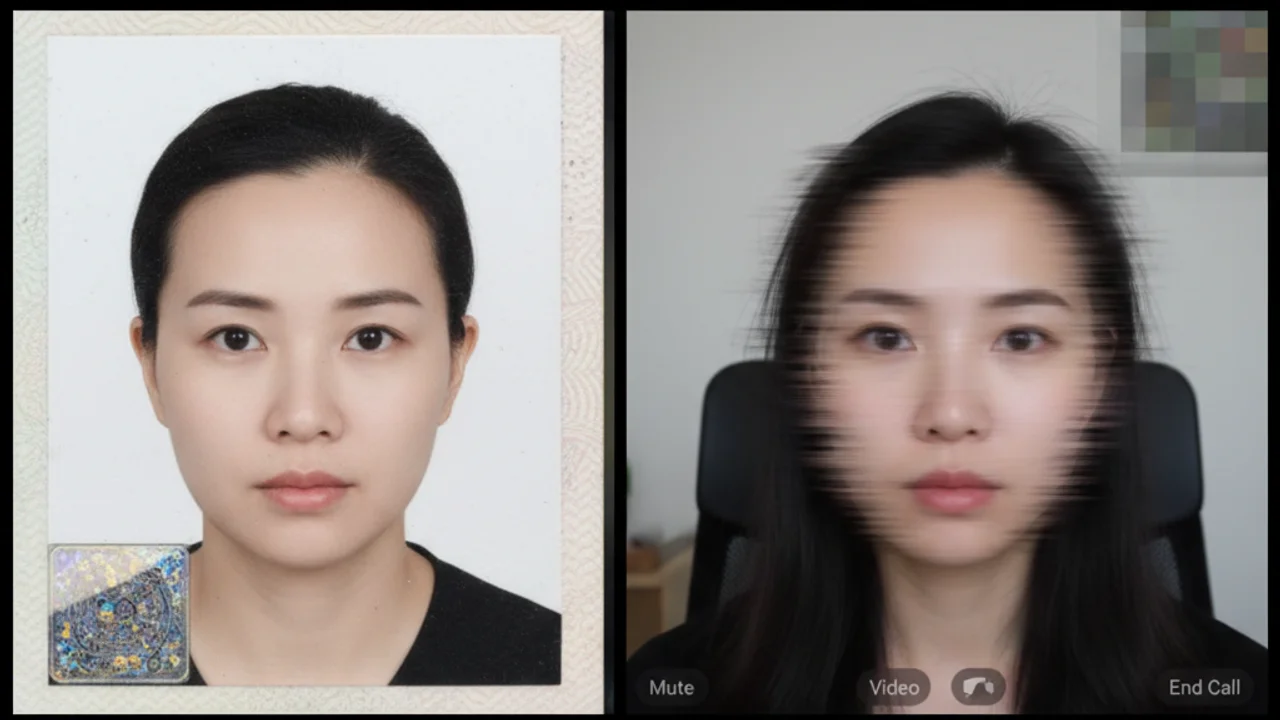
When the video interview is scheduled, the fraudster loads a real-time face-replacement tool, software that replaces their live camera feed with a synthetic face modeled after the stolen identity's photos. The output is fed into the video conferencing platform as a virtual camera. During the call, the fraudster can speak naturally while the AI renders a different face in near real time. Head tilts, expressions, and mouth movements are approximated, though rarely perfectly.
Once hired, the criminal onboards using a VPN or remote desktop relay to disguise their true geographic location. They may "employ" a team of real workers behind the scenes who handle the actual job duties while they focus on exfiltration. Payroll is typically directed to overseas cryptocurrency wallets or money mule accounts. The entire operation can run undetected for months.
The table below summarizes the attack stages and what typically happens at each phase:
Red Flags to Spot Deepfake Job Candidates
Trained HR professionals and hiring managers can spot many deepfake job candidates before an offer is extended. The following red flags should trigger additional verification:
Scan a suspicious video interview recording with Truvizy to detect deepfake manipulation before you make a hiring decision.
How Truvizy Detects Deepfake Interview Fraud
Truvizy's AI-powered multi-layer analysis is designed precisely for this threat. When you upload or submit a link to a recorded video interview at truvizy.app, the platform applies advanced pattern recognition across visual, temporal, and behavioral dimensions. The system examines frame consistency, facial boundary coherence, micro-expression authenticity, and audio-visual alignment, patterns that are statistically abnormal in deepfake-generated video but appear naturally in authentic recordings.
Truvizy's detection provides HR teams with an actionable confidence score and a plain-language breakdown of detected anomalies. Unlike generic video analysis tools, Truvizy is specifically trained on emerging synthetic media threats and updated continuously as new deepfake generation techniques emerge. For companies running high-volume remote hiring, Truvizy's analysis adds a critical verification layer that manual review cannot reliably provide at scale.
What to Do If You Encounter a Deepfake Job Applicant
If you suspect a job candidate is using deepfake technology, do not alert them during the interview. Treat the process normally to avoid tipping off an organized criminal network. Then take these steps:

Key Takeaways
- Deepfake job candidates use AI face-swapping to pass remote video interviews and then steal data, install malware, or redirect payroll to overseas accounts.
- The FBI has formally warned about this threat since 2022, with North Korean state-sponsored workers among the most organized perpetrators.
- Key detection signals include video lag on head turns, audio-visual sync problems, and photo IDs that do not match the live camera feed.
- Require in-person identity verification for finalists and scan interview recordings with Truvizy before extending offers to high-access roles.
During a video interview, you notice the candidate's face seems to glitch slightly when they turn their head quickly, and their hair edges look blurry. What is the most appropriate next step?
- Ignore it, it is probably just a bad internet connection
- End the interview immediately and accuse them of fraud
- Complete the interview normally, then scan the recording and require in-person ID verification before any offer
- Ask them to wave hello and assume everything is fine if they do
Answer: The right approach is to avoid alerting the fraudster while gathering evidence. Save the recording, scan it with AI-powered detection tools, and require live in-person or notarized ID verification before extending any offer. Never accuse without documented evidence.
Related reading: Deepfake Video Calls: How Scammers Impersonate Your Boss on Zoom: Real-time deepfake technology is being used during live Zoom and Teams calls, here is how to detect and defend against it
Related reading: How to Spot a Deepfake Video: Complete Detection Guide: Visual cues, technical tells, and AI-powered tools for identifying synthetic video content
Related reading: Deepfake Protection Guide: Defend Yourself and Your Organization: Comprehensive strategies for protecting against deepfake threats at the personal and organizational level
Frequently Asked Questions
What is a deepfake job candidate scam?
A deepfake job candidate scam occurs when a fraudster uses AI-powered face-swapping software and a stolen or fabricated identity to pass a remote video job interview. Once hired, the criminal uses their access to steal company data, deploy malware, or redirect salary payments. According to the FBI, these incidents are growing rapidly and now target technology, finance, and healthcare companies.
Can Truvizy detect deepfake job candidates?
Yes. Truvizy's AI-powered multi-layer analysis can analyze video recordings from job interviews to detect synthetic face manipulation, inconsistent lighting, unnatural blinking patterns, and audio-visual mismatches that indicate deepfake technology. HR teams can scan interview recordings directly at truvizy.app before extending an offer.
How do I know if a job applicant is using a deepfake?
Key red flags include: a slight video lag when the applicant moves their head, refusal to turn sideways or show their environment on camera, mismatched lip sync, overly smooth skin texture, hair or eyeglass edges that glitch, and inconsistency between their video appearance and submitted ID photos. Asking the candidate to perform an unexpected spontaneous action can also reveal deepfake limitations.
Which industries are most targeted by deepfake job scams?
According to FBI IC3 advisories, remote technology roles are most commonly targeted, software engineers, IT administrators, database managers, and cloud infrastructure roles. Healthcare IT and fintech are also high-value targets because of the sensitive data these roles access. The FBI specifically highlighted that North Korean IT workers have used this method to infiltrate US technology companies.
What should companies do if they hired a deepfake candidate?
Immediately suspend access to all systems, revoke credentials, and involve your incident response team or cybersecurity firm. File a report with the FBI IC3 at ic3.gov. Notify your HR and legal departments and any affected clients or data custodians. Conduct a full audit of data access and system changes made by the fraudulent employee since onboarding.