Taylor Swift Deepfake Scam 2026: The Le Creuset Giveaway That Steals Your Card
The Taylor Swift Le Creuset giveaway is an AI deepfake scam. Learn how the fake cookware offer steals your card and how to verify a celebrity video in 2026.
TL;DR
The Taylor Swift Le Creuset giveaway is an AI deepfake scam that clones her voice and likeness to offer free cookware in exchange for a small "shipping fee." Fans who pay the fee receive nothing and hand over their card details. No real celebrity runs a giveaway that asks for payment. Scan a suspicious endorsement video with Truvizy before you pay.
The video looks flawless. Taylor Swift, in her own voice, smiling into the camera, tells you she is thanking her fans by giving away 3,000 free Le Creuset Dutch ovens. All you have to do is answer a few quick questions and cover a small shipping fee. It feels believable because Swift really has talked about loving Le Creuset, and because the face and voice are unmistakably hers. It is not her. The Taylor Swift deepfake scam is an AI-generated fraud that in 2026 has turned one of the most trusted names in pop culture into bait for a cookware giveaway that delivers nothing but a drained bank card.
Celebrity-impersonation fraud is surging because the tools are cheap and the trust is free. According to the April 2026 Copyleaks investigation, a wave of TikTok ads deepfaked Taylor Swift, Rihanna, Jennifer Aniston, and Emma Watson, using textured filters to mask AI artifacts and repurposing real interview footage. Swift is a uniquely effective lure: her fans, often skewing female and highly engaged, follow her closely enough to know real details about her life, which the scam then weaponizes against them. That is exactly what makes the Taylor Swift deepfake scam so hard for a devoted fan to question.
Quick Answer
What Is the Taylor Swift Le Creuset Giveaway Scam?
The Taylor Swift deepfake scam is a celebrity-impersonation fraud that uses AI to fake the singer's likeness and promise a prize that does not exist. In the most widely circulated version, a synthetic video of Swift announces that she is giving away thousands of Le Creuset cookware sets to loyal fans. The clip is polished, verified-looking, and often runs as a paid ad or a post from a lookalike account, which lends it a false air of legitimacy.
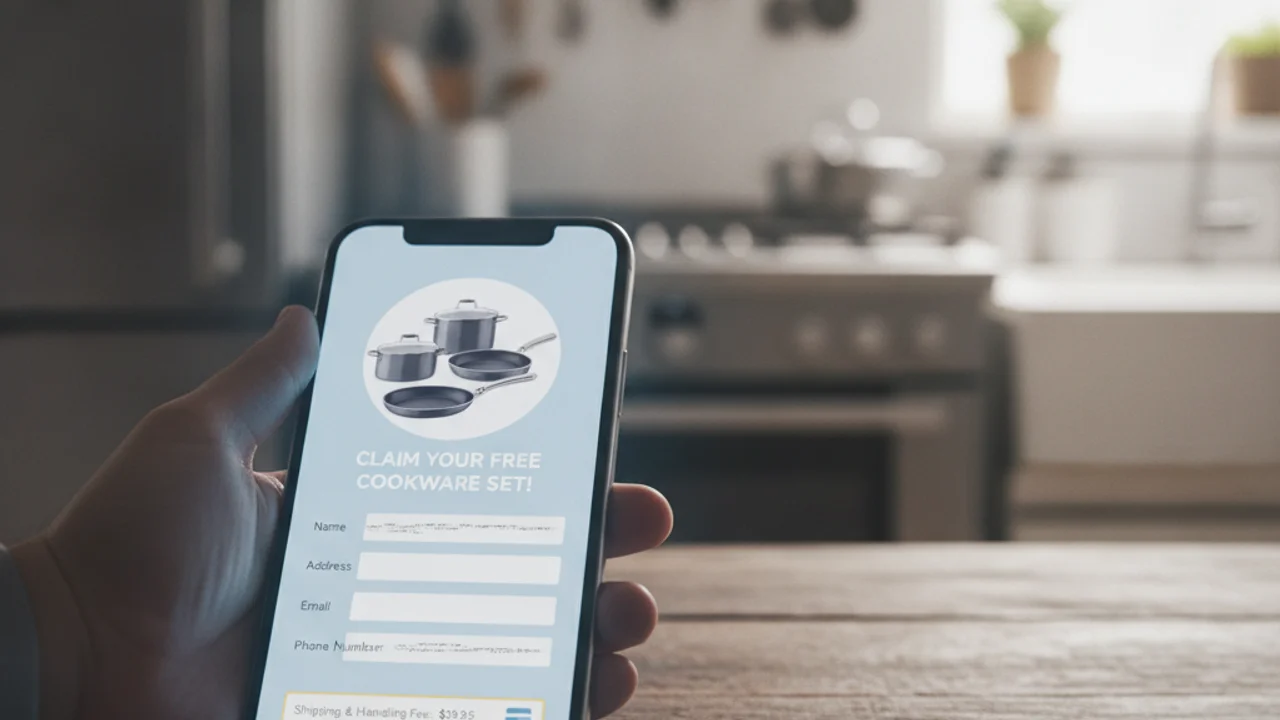
The prize is the hook, but the point is your card. The video pushes you to an off-platform page dressed up with the Le Creuset logo, fake winner testimonials, and a short survey. At the end, it asks you to pay a small shipping or handling fee, often around ten dollars, to release your free Dutch oven. There is no cookware. The page exists to capture your card number and personal details, or to enroll you in a recurring charge buried in fine print. It is a deepfake-powered evolution of the classic prize scam, and it sits alongside the broader wave of celebrity deepfake endorsement scams flooding social platforms in 2026.
Why This Deepfake Fooled So Many Fans (the "Swifties" Tell)
This scam worked because it was built on a kernel of truth. Taylor Swift has genuinely and publicly talked about her love of Le Creuset cookware, so a giveaway of exactly that product does not feel out of character. Fans who know her well enough to recognize that detail are more likely, not less, to believe the offer. The scam exploits the very knowledge that makes someone a dedicated fan, turning fandom into a vulnerability.
The audience amplifies the effect. Swift's fanbase is enormous, emotionally invested, and used to her doing generous, fan-first things, from surprise gifts to secret sessions. A deepfake that promises a thank-you present aligns perfectly with what a Swiftie already expects from her. When the face is right, the voice is right, and the gesture matches her real personality, there is little cognitive friction left to trigger suspicion.
How the $9.96 Shipping Fee Scam Drains Your Card
The build is fast and cheap. Scammers harvest Swift's vast library of public footage and audio, feed it into AI voice-cloning and face-swap tools, and produce a clip where a synthetic version of her reads a giveaway script. According to the April 2026 Copyleaks investigation into deepfaked-celebrity TikTok ads, fraudsters frequently reuse real interview footage and layer textured filters over it to mask the telltale artifacts of AI generation, then run it as a paid promotion to reach a target audience of fans.
Once a viewer is hooked, the funnel takes over. The video drives them to a link in the bio, a pinned comment, or an overlay banner leading to a convincing landing page. That page asks for name, address, and email, then presents the kicker: a roughly ten-dollar shipping or "verification" fee payable by card. Entering that card hands criminals the full number, expiry, and CVV. Some operations also drop the victim into a hidden subscription that quietly bills every month until it is spotted and cancelled. The free cookware never ships, because it never existed.
The 6 Red Flags in a Fake Celebrity Giveaway Video
Any one of these warrants a hard stop. Two or more together means you are almost certainly looking at a celebrity deepfake scam.
- <strong>It asks for any payment.</strong> A shipping fee, a handling charge, a "tax" on the prize. Real giveaways never cost money to claim.
- <strong>It pushes you off-platform.</strong> A link in bio, a pinned comment, or a banner sending you to an unfamiliar site instead of an official entry inside the app.
- <strong>It leans on a "kernel of truth."</strong> An offer that lines up suspiciously well with a known celebrity detail, like Swift and Le Creuset, is engineered to feel authentic.
- <strong>Lip-sync and lighting glitches.</strong> Watch the mouth edges, blinking, and where light falls on the face. AI face-swaps still drift on fast motion and harsh lighting.
- <strong>Wrong or off account.</strong> A handle with an extra character, a recently renamed page, or comments turned off to hide victim complaints.
- <strong>Urgency and scarcity.</strong> Countdown timers and "first 3,000 fans only" banners designed to rush you past your own judgment.
Saw a celebrity giveaway video that feels off? Scan it on Truvizy before you enter a card.
How Truvizy Detects Taylor Swift Deepfake Scams
Truvizy's AI-powered detection is built for exactly this artifact: a polished video of a real person saying something they never said. When you submit a suspected Taylor Swift giveaway clip, Truvizy's multi-layer analysis examines the face and voice for the generation signals that cloning and face-swap tools leave behind, the subtle inconsistencies around the mouth, eyes, and edges that survive even after a scammer layers filters to hide them. It weighs those signals against known impersonation and giveaway-fraud patterns to return a clear verdict.
The value is in the timing. A fan excited about a favorite star's giveaway is not going to frame-analyze a video, but they can paste a link or upload a clip in seconds. Submit the suspicious video at truvizy.app and Truvizy tells you whether the Taylor Swift on screen is genuine before you enter a card or an address. In a year where deepfake giveaways are the single most common celebrity-ad scam, that early check is the difference between a near-miss and a drained account.
What to Do If You Paid the Shipping Fee
Move fast, and do not be embarrassed. These scams are engineered to beat careful, experienced adults.
Call your card issuer immediately. If a card number was entered, report the merchant as fraudulent, dispute any charge including the small shipping fee, and request a new card number to kill any hidden subscription. Federal chargeback rights are your strongest protection on a credit card.
Lock down the accounts. Change any password you reused on the fake site, turn on two-factor authentication, and watch your email inbox for the wave of follow-on phishing that usually follows a giveaway scam.
Report the video and the fraud. Use the in-app report button on the giveaway video or ad and select the impersonation or scam category so the platform can pull it. Then file a report with the FTC at reportfraud.ftc.gov, which feeds the Consumer Sentinel database investigators rely on. The FTC's impersonation rule makes celebrity-likeness fraud directly actionable, so your report matters.
Watch for the second hit. Victims of one scam are prime targets for the next. Be wary of any "refund" or "prize recovery" message that arrives afterward, a common follow-up used to bleed victims a second time.

Key Takeaways
- The Taylor Swift Le Creuset giveaway is an AI deepfake scam that clones her voice and likeness to promise free cookware that never ships.
- The tell is the "shipping fee": any giveaway that asks for a payment, even ten dollars, is a scam, no matter how real the face and voice look.
- Scammers anchor the fake to a real detail (Swift genuinely loves Le Creuset) to make it feel authentic, so a perfect match is a reason to verify.
- Scan a suspicious celebrity giveaway video with Truvizy before paying, and if a card was entered, dispute the charge and report to the FTC fast.
Expert analysis note: Celebrity-impersonation deepfakes have shifted from novelty to industrialized fraud, and giveaways are now the most common format because they exploit a star's own goodwill against their fans. The Taylor Swift Le Creuset campaign is a textbook case of the "kernel of truth" tactic, anchoring a synthetic offer to a genuine, well-known detail about the celebrity to defeat a fan's skepticism. Truvizy's role is preventive: verify the video before the click, because once a fan's card is entered behind a small shipping fee, the loss is usually already done.
You see a verified-looking Taylor Swift video on TikTok offering free Le Creuset cookware to the first 3,000 fans, with a link in bio and a $9.96 shipping fee at checkout. What is the right move?
- Pay the $9.96 quickly, since it is only a few dollars and she really does love Le Creuset
- Enter a family member's card so your main card stays safe
- Stop, do not pay or click, and scan the video on Truvizy to confirm whether it is an AI deepfake
- Comment "done" so the giveaway bot knows to ship your cookware
Answer: A shipping fee, an off-platform link, and a real-sounding detail (Swift's love of Le Creuset) stacked together are classic deepfake-scam signals. No real celebrity charges you to claim a prize. Do not enter any card, scan the video first, and report the post inside the app.
Frequently Asked Questions
Is the Taylor Swift Le Creuset giveaway real?
No. The viral Taylor Swift Le Creuset cookware giveaway is an AI deepfake scam. Her voice and face are cloned to promise free Dutch ovens in exchange for a "small shipping fee." Once you pay, you receive nothing and the criminals keep your card details. Taylor Swift has never run a giveaway that requires a payment to claim, and neither does Le Creuset.
Why does the fake Taylor Swift video sound exactly like her?
Scammers feed hours of her public interviews and songs into AI voice-cloning tools, which can reproduce a convincing copy from just seconds of audio. According to the April 2026 Copyleaks investigation, fraudsters also repurpose real footage and add textured filters to hide AI artifacts. That is why the voice matches so well, even though the words were never spoken by her.
What happens if I paid the shipping fee for the cookware giveaway?
Act fast. Call your card issuer, report the merchant as fraudulent, dispute the charge including the small "shipping fee," and request a new card number to cancel any hidden subscription. Change any password you reused on the site, turn on two-factor authentication, and report the fraud to the FTC at reportfraud.ftc.gov so investigators can track the operation.
How can I tell if a celebrity endorsement video is a deepfake?
Watch for lip-sync drift, unnatural blinking, and lighting that does not match the face, then check whether the offer pushes you off-platform and asks for any payment. According to Surfshark, deepfake-enabled scams cost people about $1.1 billion worldwide in 2025, roughly three times 2024. When in doubt, scan the video at truvizy.app to confirm whether it is AI-generated before you act.
Where do I report a Taylor Swift deepfake scam ad?
Use the in-app report button on the video or ad and select the scam or impersonation category so the platform can remove it. Then file a report with the FTC at reportfraud.ftc.gov, which feeds the Consumer Sentinel database. Before clicking any giveaway link, scan the video at truvizy.app to verify whether the celebrity on screen is a deepfake.
Related reading: MrBeast Giveaway Scam 2026: How Deepfake Videos Push Fake iPhone and Cash Prizes — The same deepfake-giveaway playbook aimed at kids and teens
Related reading: Celebrity Deepfake Scams: How Fake Endorsements Steal Millions — The broader wave of fake celebrity endorsement videos and how to spot them
Related reading: How to Spot a Deepfake Video — Visual cues and detection methods for synthetic video content
Frequently Asked Questions
Is the Taylor Swift Le Creuset giveaway real?
No. The viral Taylor Swift Le Creuset cookware giveaway is an AI deepfake scam. Her voice and face are cloned to promise free Dutch ovens in exchange for a "small shipping fee." Once you pay, you receive nothing and the criminals keep your card details. Taylor Swift has never run a giveaway that requires a payment to claim, and neither does Le Creuset.
Why does the fake Taylor Swift video sound exactly like her?
Scammers feed hours of her public interviews and songs into AI voice-cloning tools, which can reproduce a convincing copy from just seconds of audio. According to the April 2026 Copyleaks investigation, fraudsters also repurpose real footage and add textured filters to hide AI artifacts. That is why the voice matches so well, even though the words were never spoken by her.
What happens if I paid the shipping fee for the cookware giveaway?
Act fast. Call your card issuer, report the merchant as fraudulent, dispute the charge including the small "shipping fee," and request a new card number to cancel any hidden subscription. Change any password you reused on the site, turn on two-factor authentication, and report the fraud to the FTC at reportfraud.ftc.gov so investigators can track the operation.
How can I tell if a celebrity endorsement video is a deepfake?
Watch for lip-sync drift, unnatural blinking, and lighting that does not match the face, then check whether the offer pushes you off-platform and asks for any payment. According to Surfshark, deepfake-enabled scams cost people about $1.1 billion worldwide in 2025, roughly three times 2024. When in doubt, scan the video at truvizy.app to confirm whether it is AI-generated before you act.
Where do I report a Taylor Swift deepfake scam ad?
Use the in-app report button on the video or ad and select the scam or impersonation category so the platform can remove it. Then file a report with the FTC at reportfraud.ftc.gov, which feeds the Consumer Sentinel database. Before clicking any giveaway link, scan the video at truvizy.app to verify whether the celebrity on screen is a deepfake.