How to Tell If Content Was Made by AI: Text, Images, and Video
A practical guide to identifying AI-generated text, images, and video in 2026. Learn the detection methods, tools, and visual cues that reveal synthetic content.
· By Truvizy Research Team · 8 min read
TL;DR
AI-generated content now spans text, images, audio, and video, and it is increasingly indistinguishable from human-created work. While individual detection cues like unnatural hands or robotic prose are becoming less reliable, combining multiple analysis techniques still provides strong detection capability. AI-powered detection tools that analyze patterns invisible to the human eye are now the most effective way to verify content authenticity.
The internet in 2026 is flooded with content that was never created by a human hand, spoken by a human voice, or filmed by a human camera. AI-generated text fills articles, reviews, and social media posts. AI-generated images populate news sites, dating profiles, and advertising. AI-generated video and audio create scenes and speeches that never happened. The question is no longer whether you have encountered AI-generated content, you certainly have. The question is whether you can tell the difference.
This is not just an academic concern. AI-generated content is used to create fake news, impersonate real people, manufacture evidence, manipulate markets, and execute scams. The ability to distinguish authentic from synthetic content has become a fundamental digital literacy skill, as essential as knowing how to spot a phishing email was a decade ago.
The Detection Challenge in 2026
The difficulty of detecting AI-generated content has increased dramatically as generation technology has improved. Early AI-generated images had obvious tells: distorted hands, asymmetrical faces, blurry backgrounds, and text that looked like gibberish. Those artifacts have largely been eliminated in current generation models. Similarly, early AI-generated text had a distinctive "robotic" quality, overly formal, repetitive, and lacking personality. Modern text generation produces writing that is stylistically diverse, contextually appropriate, and difficult to distinguish from human writing through casual reading.
This does not mean detection is impossible, it means it has shifted from something humans can do at a glance to something that requires deliberate analysis, specialized tools, and a combination of techniques. The detection landscape is fundamentally an arms race: as generators improve, detectors adapt, and vice versa. The good news is that there are still reliable methods for each type of content.
Detecting AI-Generated Text
AI-generated text has become the hardest category to detect reliably. Current language models produce prose that is grammatically flawless, contextually appropriate, and stylistically versatile. However, several characteristics still differentiate AI text from human writing for the careful reader.
Uniform quality and consistency. Human writing naturally varies in quality within a single piece, some paragraphs are stronger than others, some sentences are awkward, and the writer's fatigue or inspiration shows through. AI-generated text tends to maintain an unnaturally consistent quality level throughout, with every paragraph being approximately as polished as every other.
Hedging and equivocation. AI-generated text tends to qualify statements heavily, using phrases like "it is worth noting," "it is important to consider," and "while there are many factors." This pattern emerges from the model's training, which incentivizes accuracy over assertiveness. Human experts are typically more willing to make direct, unqualified claims within their area of expertise.
Lack of genuine personal experience. AI text can simulate personal anecdotes, but these fabricated stories often lack the specific, idiosyncratic details that characterize real experiences. A real person's story about getting their car towed includes the make and model of the car, the name of the street, and the frustration of paying the fine. AI-generated anecdotes tend to be more generic and structurally formulaic.
Statistical analysis tools examine the mathematical properties of text, word frequency distributions, sentence length variation, vocabulary richness, and other features that differ subtly between human and AI writing. These tools achieve moderate accuracy but are not reliable enough to use as sole determiners, particularly for short text passages.
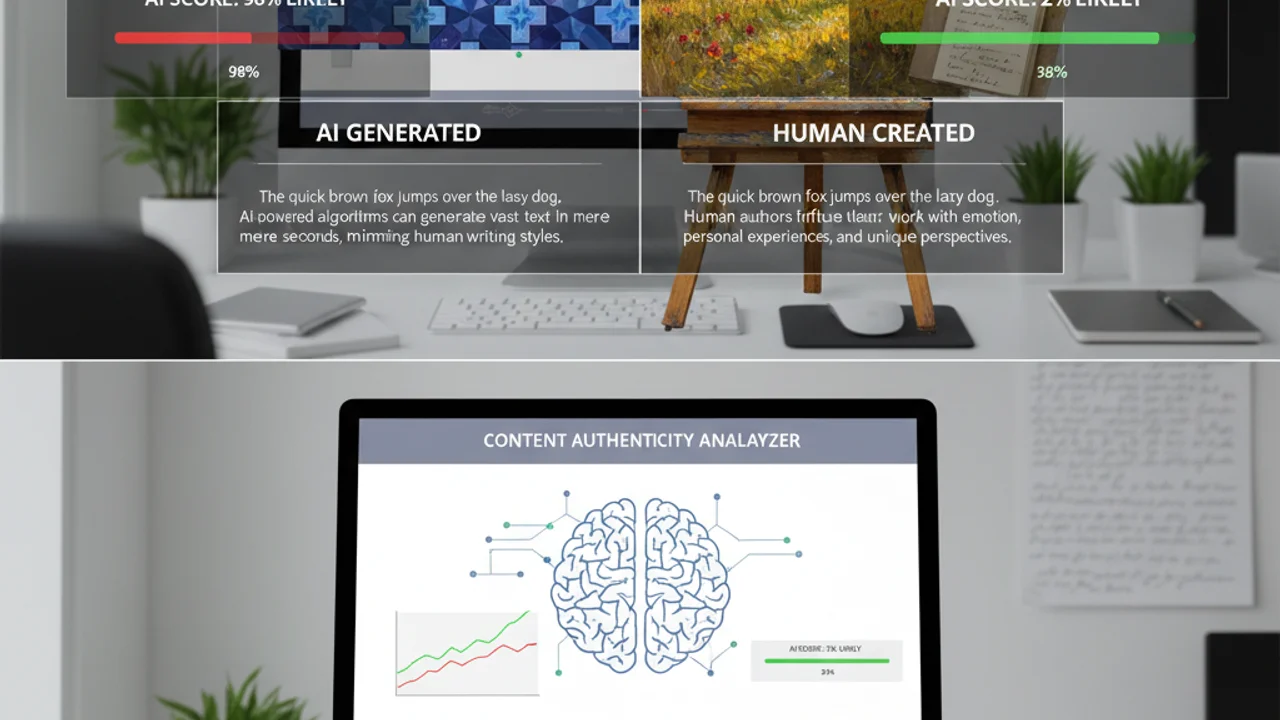
Detecting AI-Generated Images
AI-generated images have reached photorealistic quality for most subjects, but they still carry detectable signatures when examined carefully or analyzed with specialized tools.
Anatomical inconsistencies remain one of the more visible tells, though they are becoming rarer. Hands may have extra or missing fingers. Ears may be asymmetrical in unnatural ways. Teeth may appear fused or incorrectly sized. Hair, particularly at the borders where it meets the background, may show unusual patterns or abrupt transitions. Jewelry, especially earrings and necklaces, sometimes appears physically impossible.
Background coherence failures are another visual cue. Look at objects in the background, text on signs may be garbled, architectural elements may defy physics, and environmental details may be inconsistent (shadows pointing in different directions, reflections that do not match the scene). These errors are most noticeable in complex scenes with many objects and environmental interactions.
Texture and skin quality in AI-generated faces often exhibit an uncanny smoothness or an unusual quality that is hard to articulate but perceptible to careful observers. Skin may appear too perfect, lacking the pores, subtle blemishes, and texture variations that characterize real human skin in photographs.
EXIF and metadata analysis can sometimes reveal whether an image was generated rather than photographed. Real photos contain camera data, model, aperture, ISO, GPS coordinates. AI-generated images typically lack this metadata entirely, though scammers can add fake metadata to disguise generated images. The absence of metadata is suspicious; its presence requires verification.
Content provenance standards like C2PA (Coalition for Content Provenance and Authenticity) embed cryptographic records of how content was created and modified. When present, these provenance markers provide strong evidence about an image's origin. Truvizy's scanning platform can detect these provenance markers and analyze images for signs of AI generation, giving you a comprehensive assessment of image authenticity.
Upload a suspicious image to check for AI generation artifacts and manipulation signs.
Detecting AI-Generated Video
AI-generated video, including both fully synthetic video and deepfakes that overlay one person's face onto another's body, presents unique detection challenges and opportunities. Video contains temporal information that provides additional detection signals not available in still images.
Temporal inconsistencies are the most reliable visual detection cue. AI-generated video may exhibit micro-glitches between frames, subtle flickering, objects that shift slightly between consecutive frames, or edges that shimmer unnaturally. These artifacts are often invisible at normal playback speed but become apparent when video is viewed frame-by-frame or at reduced speed.
Face-body mismatches in deepfake videos can reveal manipulation. The overlay face may not perfectly match the lighting on the body, may have slightly different skin tone, or may move with subtle lag relative to head movements. The boundary between the overlaid face and the original footage is the most vulnerable point and may show blending artifacts.
Audio-visual synchronization in deepfake videos is improving but still imperfect. Lip movements may lag slightly behind audio, or may not precisely match the phonemes being spoken. This is particularly noticeable in languages with distinctive mouth shapes for certain sounds.
Our comprehensive article on the growing threat of synthetic media explores deepfake video detection in greater detail, including the specific types of manipulation used in political disinformation and financial fraud.
Detecting AI-Generated Audio
AI voice synthesis has become remarkably convincing, but several characteristics can help identify synthetic speech.
Breathing patterns are one of the most reliable indicators. Natural speech includes breathing sounds, inhales before long sentences, slight pauses for breath, and the general rhythm of breathing that accompanies speech. AI-generated audio may lack these entirely or insert them at unnatural intervals.
Emotional range in synthetic speech tends to be more limited than in natural human speech. While AI can simulate basic emotions, happiness, sadness, anger, the subtle emotional nuances of real human speech are difficult to replicate. A genuine voice that transitions from discussing a mundane topic to recalling a painful memory carries emotional micro-variations that synthetic voices typically cannot reproduce.
Environmental audio consistency provides another signal. Real recordings contain ambient noise that changes naturally as the speaker moves or the environment shifts. AI-generated audio may have unnaturally clean audio or environmental sounds that do not match the claimed setting.

You receive a profile photo from someone you met online. The person looks attractive and natural, but the image has no EXIF metadata and a reverse image search returns zero results. What is the most likely explanation?
- The person is very private and has never posted their photo online before
- The image may be AI-generated, no metadata and no search results are both red flags
- The photo is definitely authentic since it looks natural
- Reverse image search not finding results proves the photo is original
Answer: AI-generated photos have no metadata from a real camera and do not appear in reverse image searches because the person never existed. Both of these are significant red flags that warrant further verification using AI-powered detection tools.
Tools and Techniques for Verification
The most effective approach to content verification combines multiple methods. No single technique is fully reliable, but the convergence of multiple signals provides strong evidence.
AI-powered detection platforms are the most effective tools available for non-experts. These platforms analyze content using algorithms trained to detect the statistical signatures of AI generation, patterns that are invisible to human perception but consistently present in synthetic content. Truvizy's scanning plans provide access to multi-layer analysis that examines images and video for generation artifacts, manipulation signs, and provenance markers.
Reverse image and video search remains useful for content that uses stolen rather than generated media. Google Images, TinEye, and specialized platforms can identify when a photo or video frame appears elsewhere online, potentially revealing its true origin.
Source verification is a foundational technique. Before trusting any piece of content, consider where it came from. Is it published by a reputable source? Can it be corroborated by independent sources? Does the source have a track record of accuracy? The origin of content is often more informative than any technical analysis of the content itself.
Contextual analysis examines whether the content makes sense in its claimed context. A photo of a political figure in an unlikely location, a quote that does not match the speaker's known positions, or a video that conveniently supports a particular narrative during a sensitive time should all trigger additional scrutiny.
Get comprehensive AI-powered content verification for images, video, and more.
Building Critical Media Literacy
Beyond specific tools and techniques, developing a habit of critical engagement with digital content is the most durable defense against AI deception. This means approaching all content with a calibrated level of skepticism, not paranoid disbelief, but thoughtful evaluation.
Ask yourself why this content exists. Who created it, and what was their purpose? Does it provoke a strong emotional reaction, which might be the point rather than a side effect? Is it asking you to make a decision or take an action? Content designed to manipulate typically pushes for action, sharing, clicking, paying, voting, rather than simply informing.
Verify before you share. The viral spread of AI-generated content depends on people sharing without verifying. Taking even thirty seconds to check a claim, search for a photo's origin, or look for corroborating sources can break the chain of misinformation. If you cannot verify it, do not amplify it.
Stay informed about the capabilities and limitations of current AI technology. Understanding what AI can and cannot do helps you calibrate your skepticism appropriately. Follow developments in both AI generation and detection, as this is a rapidly evolving field. Our article on how AI is making scams more dangerous provides context on how these technologies are being weaponized in the current threat landscape.
The ability to distinguish real from synthetic content is rapidly becoming one of the most important skills for navigating the digital world. It is not about being suspicious of everything, it is about being equipped to ask the right questions and having access to tools that can provide answers. In 2026, that means combining human critical thinking with AI-powered analysis, because the threats we face use both, and so must our defenses.
Key Takeaways
- No single detection method is fully reliable, layer multiple techniques for best results.
- AI-generated images still leave detectable signatures in hands, teeth, backgrounds, and metadata.
- AI-powered detection tools outperform human visual inspection for identifying synthetic content.
- Developing critical media literacy habits, pause, verify, then share, is your most durable defense.
Related reading: How to Spot a Deepfake Video: Visual cues and tools for identifying manipulated video content
Related reading: How to Verify Video Authenticity: Step-by-step guide to confirming video content is real
Related reading: How Truvizy Detects Scams: The multi-layer AI technology behind content verification
Frequently Asked Questions
How accurate are AI detection tools?
The best AI detection tools achieve 85-95% accuracy for images and 70-85% for text, depending on the content and the generation model used. No tool is perfect, and detection accuracy varies by content type. Using multiple detection methods simultaneously improves reliability.
Can AI detect AI-generated content?
Yes, AI-powered detection tools are currently the most effective method for identifying synthetic content. These tools analyze statistical patterns, compression artifacts, and generation signatures that are invisible to human observers but consistently present in AI-generated material.
Are AI watermarks reliable?
Some AI generation tools embed invisible watermarks in their output, and initiatives like C2PA create content provenance trails. While these are promising, they are not yet universal and can sometimes be removed or circumvented. Watermarks are a helpful signal when present but should not be the sole detection method.
Will AI-generated content eventually be undetectable?
Detection and generation are in an ongoing arms race. While generation quality continues to improve, detection methods also advance. The consensus among researchers is that there will always be detectable differences between AI-generated and authentic content, though finding them will require increasingly sophisticated tools.
Should I assume all online content might be AI-generated?
Healthy skepticism is appropriate but should not become paralyzing cynicism. Focus verification efforts on content that could influence important decisions, health advice, financial information, news stories, and the identity of people you interact with online.