"Is This Text a Scam?" Red Flags in Every Suspicious SMS
Wondering if a text message is a scam? Learn the red flags in every suspicious SMS in 2026: fake delivery alerts, wrong-number openers, bank fraud warnings, and the exact checks that expose smishing in seconds.
TL;DR
Almost every scam text shares the same red flags: an unknown number, a link you did not expect, manufactured urgency, a request for personal or payment information, and a story that pressures you to act now. Running these checks before you tap anything stops the vast majority of smishing attacks. When you are unsure, scan the link or message with Truvizy before you engage.
Your phone buzzes. "USPS: Your package is held at our facility due to an incomplete address. Update your details within 24 hours to avoid return: usps-redelivery.info/track." You were expecting a delivery. The message looks official. Your thumb hovers over the link. Before you tap, one question matters more than any other: is this text a scam? You have about five seconds before habit and urgency answer it for you.
What Is a Text Message Scam (Smishing)?
A text message scam, known as "smishing" (SMS phishing), is a fraudulent text designed to trick you into clicking a malicious link, revealing personal information, or sending money. The name combines "SMS" and "phishing" because the tactics are identical to email phishing, simply delivered to the device you check most often and trust most instinctively.
Text scams work so well precisely because of that trust. People open texts within minutes and read them at a glance, often while distracted. A message sits in the same inbox as notes from family, your doctor, and your bank. According to the FTC's 2025 Consumer Sentinel data, consumers reported losing hundreds of millions of dollars to text scams, with fake package-delivery notifications the most reported type by a wide margin.
The scale is industrial. Industry analysis from RoboKiller estimated Americans received well over a billion scam and spam texts on peak days in 2025. Scammers send messages in enormous bulk batches to randomly generated or breached numbers, betting that a small percentage of recipients will be expecting a package, worried about their bank, or hopeful about a job at exactly the moment the text lands.
How Text Message Scams Work
Nearly every smishing campaign follows the same four-step architecture, even as the specific stories change week to week. Understanding the mechanics reveals exactly where to break the chain.
1. The bulk send. Scammers blast the same message to thousands or millions of numbers using cheap automated tools, often spoofing the sender ID or routing through overseas SMS gateways so the origin is hidden. Your number does not need to have been "hacked" to receive one.
2. The believable pretext. The message impersonates something you are likely to care about right now: a held package, a bank fraud alert, a toll you supposedly owe, a suspended account, or a job offer. The best pretexts are ones almost everyone encounters, which is why delivery and banking themes dominate.
3. The link or the hook. The text pushes you toward a single action: tapping a link to a fake login or payment page, calling a number that reaches a fake "support" agent, or replying to start a conversation. The destination page is usually a near-perfect clone of a real brand's site, built to capture whatever you type.
4. The extraction. Once you enter credentials, card details, or a one-time verification code, the scammer harvests it in real time, often using it within minutes to drain an account, make purchases, or take over the account entirely. Some campaigns skip the link and instead ask you to send a payment directly or to forward a code that unlocks your own account.
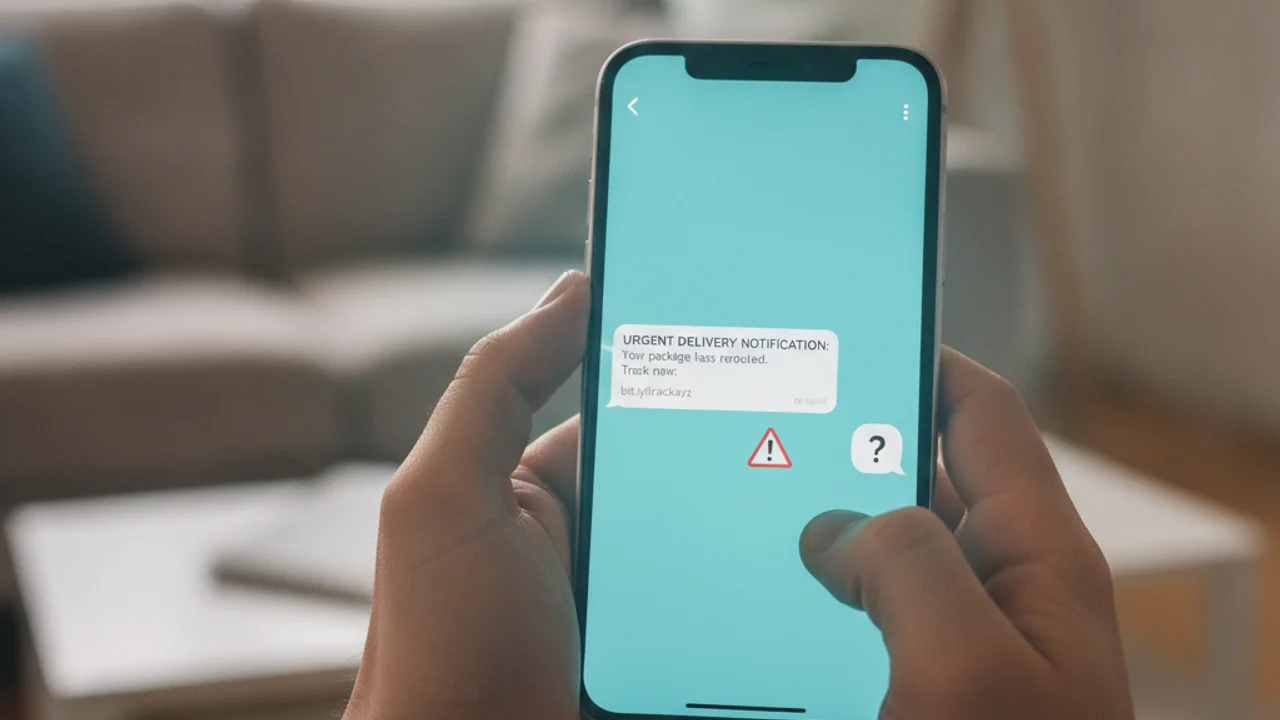
Red Flags in Every Suspicious SMS
Almost every scam text carries at least two of these red flags. Learn to spot them in order and you will catch the overwhelming majority of smishing attempts before they cost you anything.
An unknown or generic number. Legitimate businesses text from consistent short codes or verified numbers. A message from a random 10-digit mobile number, an email-to-text address, or an international code you do not recognize is an immediate warning, especially when it claims to be a bank or a courier.
An unexpected link. If you did not request a text with a link, treat every link as hostile. Shortened URLs, lookalike domains, and unusual endings (.info,.xyz,.top) are hallmarks of smishing. Real companies rarely send you to a random domain to "verify" anything.
Manufactured urgency. "Within 24 hours," "final notice," "account suspended," "avoid a penalty." Time pressure is engineered to stop you from thinking. Real organizations do not threaten immediate catastrophe over SMS for routine issues.
A request for sensitive information. No legitimate bank, courier, or government agency will text you asking for your password, full card number, Social Security number, or a verification code. Any such request is a confirmed scam.
A "wrong number" or too-friendly opener. Messages like "Hi, is this Sarah? We met at the conference" or "Hello, are you free for a remote job paying $300/day?" are designed to start a conversation that later pivots to a crypto investment or task scam. A stranger who keeps chatting after you say they have the wrong number is running a script.
An offer or threat that does not match reality. A prize for a contest you never entered, a refund you were not owed, a toll for a road you never drove, or a fine from an agency that does not text. When the story does not line up with your life, it is bait.
Got a suspicious text with a link? Scan it with Truvizy before you tap. You never have to open it to find out if it is safe.
You get a text: 'FedEx: your parcel is on hold. A $2.99 redelivery fee is required. Pay here: fedex-parcel-update.info/pay'. What is the safest move?
- Pay the $2.99, it is a tiny amount and the package might be real
- Tap the link to check the details, but do not enter your card
- Do not tap anything; open the official courier app or website directly to check any real delivery
- Reply asking FedEx to confirm the fee
Answer: The domain (fedex-parcel-update.info) is not FedEx's real domain, and couriers do not collect fees by text link. Even opening the page can expose you. Never pay or enter details. Check a genuine delivery only through the courier's official app or by typing their real website address yourself. Replying just confirms your number is active.
How Truvizy Detects Text Message Scams
The hardest part of a scam text is that you often cannot tell whether a link is dangerous without opening it, and opening it is exactly what puts you at risk. Truvizy's AI-powered analysis removes that trade-off. You can paste a suspicious link or upload a screenshot of the text, and Truvizy examines the destination and the message for phishing patterns and known fraud indicators, all without you ever having to tap the link yourself.
For links, Truvizy's multi-layer analysis inspects the destination URL, checks for lookalike and newly registered domains, and compares it against known credential-harvesting patterns, catching the fake bank and courier pages that smishing relies on. For screenshots and forwarded media, Truvizy evaluates the content for the classic markers of a scam message. Visit truvizy.app to scan any suspicious text in seconds before you decide whether to trust it.
Truvizy is built for exactly the moment described at the top of this article: the five seconds between receiving a text and reacting to it. Instead of guessing whether a message is real, you get a clear, fast answer, which is especially valuable for protecting family members who are more likely to act on a convincing delivery or bank alert.
What to Do If You Get a Scam Text
Do not tap, and do not reply. Not the link, not "STOP," not a question. Any response confirms your number is live and monitored, which typically increases the volume of scam texts you receive rather than reducing it.
Verify through an independent channel. If the text claims to be from your bank, courier, or a government agency, look up their real contact details yourself, through their official app or by typing their website address directly, and confirm there. Never use a phone number or link from the suspicious message itself.
Scan the link before trusting it. If you need to know whether a link is safe, use Truvizy's free scanning tool rather than opening the page yourself. It takes seconds and keeps you off the malicious site entirely.
Report the message. In the US, forward the scam text to 7726 (which spells SPAM), which alerts your carrier. Then file a report with the FTC at reportfraud.ftc.gov. If you lost money, file a complaint with the FBI's Internet Crime Complaint Center at ic3.gov.
Block and delete. After reporting, block the sender and delete the message so you do not tap it later by accident.
If you already clicked or entered information: change the password for any account involved from a different device, enable two-factor authentication using an authenticator app, and call your bank using the number on the back of your card if you shared financial details. If you entered your Social Security number, place a fraud alert or credit freeze with the three credit bureaus. Our guide to smishing text scams covers the full recovery checklist.
AI-written scam texts are grammatically flawless now. Automated detection gives you a reliable second layer of protection.
Key Takeaways
- Every scam text shares the same red flags: an unknown number, an unexpected link, manufactured urgency, a request for sensitive information, and a story that pressures you to act now.
- Fake package-delivery texts are the single most reported smishing type. A courier will never collect a fee or ask you to "update your address" through a random link.
- Never reply to a suspected scam text, not even STOP; replying confirms your number is active. Forward it to 7726 (SPAM) and report it at reportfraud.ftc.gov instead.
- When you are unsure, scan the link or a screenshot with Truvizy before engaging. You never have to open a malicious page to find out it is dangerous.
Expert analysis note: text-message fraud has overtaken email as the fastest-moving phishing channel because SMS combines near-universal reach with the intimacy and speed of a device people trust reflexively. AI writing tools have erased the spelling and grammar tells that once exposed scam texts, so the reliable signals in 2026 are structural, not stylistic: who sent it, where the link actually goes, and whether the request makes sense. Individuals who build the habit of verifying through independent channels and scanning suspicious links before acting are dramatically less likely to become victims. Truvizy exists to provide that verification layer in the exact moment human judgment is under the most pressure.
Related reading: Smishing: How to Spot Text Message Scams — The complete breakdown of SMS phishing tactics and the full recovery checklist if you already responded
Related reading: Is This Email a Scam? How to Tell in 5 Seconds — The same red-flag method applied to email phishing: sender spoofing, urgency, and suspicious links
Related reading: WhatsApp Scams in 2026: The 8 Most Dangerous Messages — How the same smishing tactics migrate to messaging apps and how to stop them
Frequently Asked Questions
How can I tell if a text message is a scam?
Check five things before you tap anything: the number (unknown or generic), the link (unexpected or a shortened or lookalike URL), the tone (urgent or threatening), the ask (personal details, a payment, or a verification code), and the story (a package, a bank alert, or a job you never expected). If two or more apply, treat the text as a scam and do not reply or click.
What should I do if I clicked a link in a scam text?
Do not enter any information on the page that opened. Close the browser tab, then run a security scan on your phone. If you already typed a password or card number, change that password immediately and call your bank using the number on the back of your card. Report the text by forwarding it to 7726 (SPAM) and filing a report at reportfraud.ftc.gov.
Can Truvizy detect text message scams?
Yes. Truvizy's AI-powered analysis can scan any link, screenshot, or media from a suspicious text before you engage with it. Paste the link or upload a screenshot at truvizy.app and Truvizy checks the destination and content for phishing patterns and known fraud indicators in seconds, so you never have to open the link yourself to find out whether it is safe.
Why do I keep getting scam texts about packages I never ordered?
Fake delivery texts are the single most reported text scam. Scammers send them in bulk to millions of numbers because almost everyone is expecting a package at some point, which makes a "delivery problem" believable. According to the FTC, package-delivery messages are consistently among the top reported text scams, so receiving one does not mean your data was breached.
Is it safe to reply STOP to a scam text?
No. Replying anything, including STOP, confirms your number is active and monitored, which usually leads to more scam texts, not fewer. STOP only works for legitimate marketing senders who follow the rules. For a suspected scam, do not reply at all. Instead, forward the message to 7726 (SPAM), then block and delete it.