UK Senior Scam Statistics 2026: 1.9 Million Older People Defrauded of £7.4 Billion
Nearly 1.9 million older people in the UK have been scammed, losing an average of £4,000 each. See the Action Fraud and UK Finance data and how to verify before you pay.
TL;DR
An estimated 1.9 million older people in the UK have been scammed out of a combined £7.4 billion, with 61% of people over 65 targeted by fraud and the typical victim losing close to £4,000 in a single scam, according to Independent Age. Over half of over-65s (55%) cannot reliably tell a genuine bank text from a fake one. Authorised push payment fraud, where a victim is tricked into approving a payment themselves, rose 19% in 2025 to £576.4 million across the UK, with investment scams up 55%. Before approving any payment, call, or link, verify independently: scan the message or video with Truvizy, and report to Action Fraud or your bank via the 159 hotline.
A widow in her seventies in Manchester receives a text that appears in the same message thread as her genuine bank alerts, warning of suspicious activity and providing a number to call. She rings it. The person who answers knows her name, her bank, and the last four digits of her card. Over the next hour, calmly and patiently, they walk her through "securing" her account, which really means moving her savings into an account the fraudsters control. Nothing about the interaction felt rushed or crude. That is precisely the problem: according to Independent Age, roughly 1.9 million older people across the UK have been scammed this way, for a combined total of about £7.4 billion.
The numbers describe a problem that has moved well beyond the classic cold-call scam. Independent Age's research found that 61% of people over 65 have been targeted by a scam attempt in the past year, and 17% say they were actually defrauded, with an average loss of close to £4,000 per incident. Nationally, UK Finance's Annual Fraud Report shows authorised push payment fraud, the kind where a victim is manipulated into approving the transfer themselves, rose 19% in 2025 to £576.4 million, with investment scam losses up 55%. The tactics have gotten calmer, more patient, and far harder to spot.
Quick Answer
How Big Is the Senior Scam Problem in the UK?
The scale documented by Independent Age is striking: an estimated 1.9 million older people across the UK have fallen victim to a scam, with combined losses of roughly £7.4 billion. In just the past 12 months, 61% of people over 65 report being targeted by a scam attempt, and 17% say they actually lost money, at an average of nearly £4,000 per incident, a devastating hit for anyone living on a fixed retirement income.
The national fraud picture reinforces this. UK Finance's Annual Fraud Report found authorised push payment (APP) fraud, where the victim is deceived into authorising the payment themselves rather than having it stolen directly, rose 19% across 2025 to £576.4 million. Investment scams were the single biggest driver of that increase, up 55% to £97.7 million, and around 70% of all APP fraud cases now begin online, on social media, in messaging apps, or through fake websites, rather than over the phone.
The Scams Costing UK Seniors the Most
A handful of tactics account for the overwhelming majority of losses among older victims in the UK.
- <strong>Bank and fraud-team impersonation.</strong> A text or call, often spoofed to appear in the same thread as genuine bank alerts, warning of "suspicious activity" and walking the victim through moving money to a "safe account" that belongs to the fraudster.
- <strong>Investment scams: £97.7 million, up 55%.</strong> Fake trading platforms and cryptocurrency schemes, frequently promoted through deepfake celebrity or financial-expert endorsements on social media.
- <strong>Romance scams.</strong> A relationship built over weeks or months online that ends in a request for money to cover a fabricated emergency, a common tactic against older, often recently bereaved, victims.
- <strong>Courier and "police officer" scams.</strong> A caller claims to be a police officer or bank investigator and asks the victim to withdraw cash or hand over a bank card to a "courier" for safekeeping during a fraud investigation.
- <strong>Tech support scams.</strong> A fake pop-up warning convinces a victim their computer has been compromised, then talks them into installing remote-access software or paying for bogus "protection."
Why Older Victims Cannot Spot the Fakes Anymore
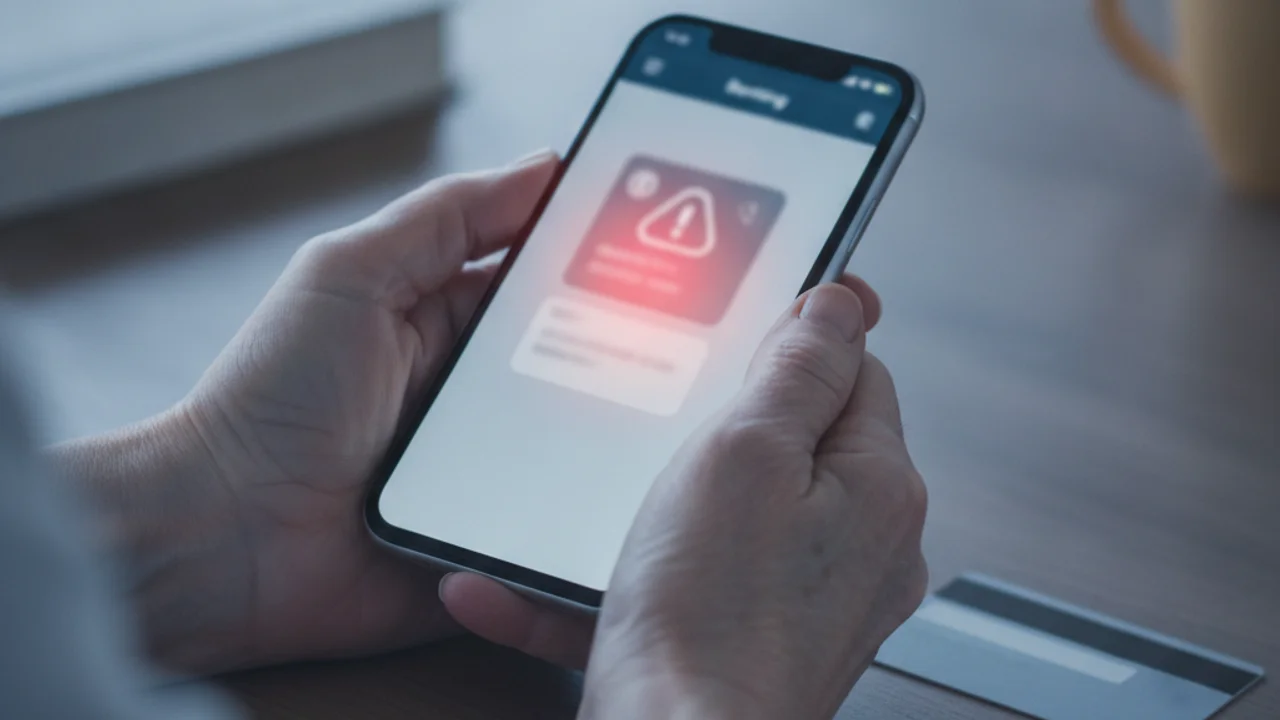
The most striking finding in Independent Age's research is not how many people are targeted, it is how hard the scams have become to identify. More than half of over-65s (55%) say they cannot reliably tell a genuine bank text message from a fraudulent one. That is not a failure of vigilance, it is a reflection of how convincingly fraud has been engineered: spoofed sender IDs that slot fake messages into the same thread as real bank alerts, and increasingly, AI-generated voices and videos that make impersonation calls sound completely authentic.
This mirrors a pattern seen across every English-speaking country: scammers now use a few seconds of someone's voice, often lifted from a video posted online, to clone it convincingly enough to fake a distressed call from a family member or a bank representative. For a full breakdown of how this works, see our guide on AI voice cloning scams. The practical result is the same for UK families as anywhere else: a familiar voice or a professional-looking text is no longer reliable proof of who is really on the other end.
Got a text, call, or investment link that feels off? Scan it with Truvizy before you approve any payment.
The Toll Beyond the Money
Independent Age's data makes clear that the damage from a scam is not purely financial. Alongside the 31% who report a mental health impact and 12% who report worsened physical health, 45% say the experience negatively affected their overall financial wellbeing, a hit that compounds for anyone on a fixed pension income with little room to absorb an unexpected loss.
Underreporting compounds the problem. Nearly three in ten (29%) of scammed over-65s did not report the fraud at all, and 21% found the reporting process too confusing to pursue. Some victims mistook a scam communication for a routine transactional message and never realized anything was wrong until money had already gone. This is exactly why proactive verification, checking before you act rather than untangling the damage afterward, matters so much more than reporting alone.
How Truvizy Detects These Scams
The defining challenge of today's UK scams is that they are engineered to pass a normal gut check, a text that looks exactly like your bank, a call from someone who already knows your details, a video endorsement that looks completely real. That is exactly the gap Truvizy is built to close. When a message, call, video, or investment link feels off, you can run it through Truvizy's AI-powered detection instead of relying on instinct alone. Truvizy's multi-layer analysis checks media and messages against known scam and synthetic-content patterns and returns a clear result in seconds.
That check matters most in the moment a scammer is applying calm, patient pressure, exactly when it is hardest to step back and question what is happening. Submit the suspicious text, call recording, video, or link at truvizy.app and get a clear answer before any payment is approved, not after.
How to Verify Before You Approve a Payment
A short, practiced routine stops the large majority of these scams, no matter how convincing they appear.
Hang up and call back using a number you already trust. Never use a number or link provided inside the suspicious text or call. Find your bank's number on the back of your card or their official website, and call from there instead.
Use 159 if you suspect a bank impersonation call. The UK's dedicated fraud hotline connects you directly to your bank's genuine fraud team, bypassing anything the caller may have told you.
Set a family code word. Agree on a private phrase with close family that would never appear online. If anyone calls claiming a family emergency, ask for the code word first. See our full guide on setting up a family code word for the exact steps.

How to Report a Scam in the UK
Reporting promptly helps investigators and improves your own chance of recovery. Report to Action Fraud at actionfraud.police.uk or by phone on 0300 123 2040. If you think you are mid-call with someone impersonating your bank, hang up and dial 159, the Stop Scams UK hotline that connects you securely to your real bank's fraud team. Forward suspicious text messages to 7726, free on every major UK network, to help block the sender. If a payment has already been made, contact your bank immediately, since under the Payment Systems Regulator's reimbursement rules most authorised push payment fraud victims are entitled to a refund, but speed still matters for stopping a transfer before it clears.
Key Takeaways
- Around 1.9 million older people in the UK have been scammed out of a combined £7.4 billion, with 61% of over-65s targeted in the past year (Independent Age).
- Authorised push payment fraud rose 19% across the UK in 2025 to £576.4 million, with investment scams up 55% to £97.7 million (UK Finance).
- More than half of over-65s (55%) cannot reliably tell a genuine bank text from a fake one, a gap AI-generated voices and spoofed messages are actively exploiting.
- Verify before you approve any payment: hang up and call back on a trusted number, dial 159 for suspected bank impersonation, and scan suspicious messages with Truvizy. Report to Action Fraud.
Expert analysis note: the UK data reveals a scam landscape that has shifted from crude to clinical. The 55% of over-65s who cannot distinguish a real bank text from a fake one is not a literacy problem, it reflects genuinely convincing fraud infrastructure, spoofed sender IDs, patient scripted calls, and increasingly AI-generated voices and video. Because 70% of authorised push payment fraud now starts online rather than over a traditional phone call, and because investment scam losses grew 55% in a single year, the fastest-growing risk sits precisely where older adults are moving more of their financial lives: digital channels their generation trusts less instinctively to scrutinize. Independent verification before approving any payment is now the single highest-leverage defense available.
You receive a text that appears in the same thread as your genuine bank alerts, warning of suspicious activity and providing a number to call. What is the safest next step?
- Call the number provided in the text immediately since it appeared in your real bank thread
- Ignore it completely and delete the message
- Call your bank using the number on the back of your card, or dial 159, rather than any number or link in the text
- Reply to the text asking for more details
Answer: Scammers can spoof sender IDs so a fake text appears in the same thread as genuine bank messages, which is exactly why the message itself cannot be trusted, even if it looks legitimate. Always verify using a number you already know is correct, such as the one on your card, or call 159 to reach your bank's real fraud team directly.
Frequently Asked Questions
How many older people in the UK have been scammed?
Research from Independent Age found that around 1.9 million older people in the UK have been scammed, with a combined total of roughly £7.4 billion lost. In the past year alone, 61% of people over 65 say they have been targeted by a scam attempt, and 17% say they actually fell victim, losing an average of close to £4,000 per incident.
What is the most common scam targeting UK seniors right now?
Authorised push payment (APP) fraud, where the victim is tricked into approving a bank transfer themselves, most commonly investment scams and impersonation scams, is the fastest-growing category. UK Finance recorded £576.4 million in APP fraud losses across 2025, up 19% year on year, with investment scam losses alone up 55% to £97.7 million. Around 70% of these scams now start online.
Why do older people struggle to spot scam texts and calls?
Independent Age found that 55% of people over 65 cannot reliably tell a genuine bank text message from a fraudulent one, as scam messages have become increasingly polished and can spoof a real bank's sender ID so it appears in the same message thread as genuine texts. Combined with a wariness that makes older people cautious of hanging up on someone claiming to be their bank, this makes voice and text impersonation especially effective.
How do I report a scam in the UK?
Report to Action Fraud at actionfraud.police.uk or by calling 0300 123 2040. If you are in the middle of a suspicious call and think you might be talking to a scammer pretending to be your bank, hang up and call 159, the Stop Scams UK hotline that connects you directly to your bank's fraud team. Report suspicious texts by forwarding them to 7726, free on all major UK networks.
Can I get my money back after being scammed in the UK?
It depends on the situation. Under the Payment Systems Regulator's mandatory reimbursement rules, most victims of authorised push payment fraud are entitled to a refund from their bank, though there are some exceptions and a claim excess may apply. Report to your bank immediately, since faster action improves the chance of stopping a payment before it is fully processed, and report to Action Fraud regardless of whether the money is recovered.
Related reading: AI Voice Cloning Scams: How Criminals Fake a Familiar Voice — The technology behind the impersonation calls UK banks are warning about
Related reading: How to Scam-Proof Your Elderly Parents — A practical, respectful framework for protecting the people you love
Related reading: Phishing Email Detection Guide — Spot the fake bank and government messages before you click
Frequently Asked Questions
How many older people in the UK have been scammed?
Research from Independent Age found that around 1.9 million older people in the UK have been scammed, with a combined total of roughly £7.4 billion lost. In the past year alone, 61% of people over 65 say they have been targeted by a scam attempt, and 17% say they actually fell victim, losing an average of close to £4,000 per incident.
What is the most common scam targeting UK seniors right now?
Authorised push payment (APP) fraud, where the victim is tricked into approving a bank transfer themselves, most commonly investment scams and impersonation scams, is the fastest-growing category. UK Finance recorded £576.4 million in APP fraud losses across 2025, up 19% year on year, with investment scam losses alone up 55% to £97.7 million. Around 70% of these scams now start online.
Why do older people struggle to spot scam texts and calls?
Independent Age found that 55% of people over 65 cannot reliably tell a genuine bank text message from a fraudulent one, as scam messages have become increasingly polished and can spoof a real bank's sender ID so it appears in the same message thread as genuine texts. Combined with a wariness that makes older people cautious of hanging up on someone claiming to be their bank, this makes voice and text impersonation especially effective.
How do I report a scam in the UK?
Report to Action Fraud at actionfraud.police.uk or by calling 0300 123 2040. If you are in the middle of a suspicious call and think you might be talking to a scammer pretending to be your bank, hang up and call 159, the Stop Scams UK hotline that connects you directly to your bank's fraud team. Report suspicious texts by forwarding them to 7726, free on all major UK networks.
Can I get my money back after being scammed in the UK?
It depends on the situation. Under the Payment Systems Regulator's mandatory reimbursement rules, most victims of authorised push payment fraud are entitled to a refund from their bank, though there are some exceptions and a claim excess may apply. Report to your bank immediately, since faster action improves the chance of stopping a payment before it is fully processed, and report to Action Fraud regardless of whether the money is recovered.