AI-Generated News Anchors: The New Face of Disinformation
Learn how AI-generated news anchors are being used to spread disinformation at scale. Understand the technology, the threat, and how to identify synthetic news content.
· By Truvizy Research Team · 8 min read
TL;DR
Criminal and state-sponsored operations are creating entire fake news broadcasts featuring AI-generated anchors to spread disinformation at scale. These synthetic news segments mimic the visual authority of professional journalism, making false narratives more believable. Always verify news through multiple established sources and scan suspicious broadcast clips.

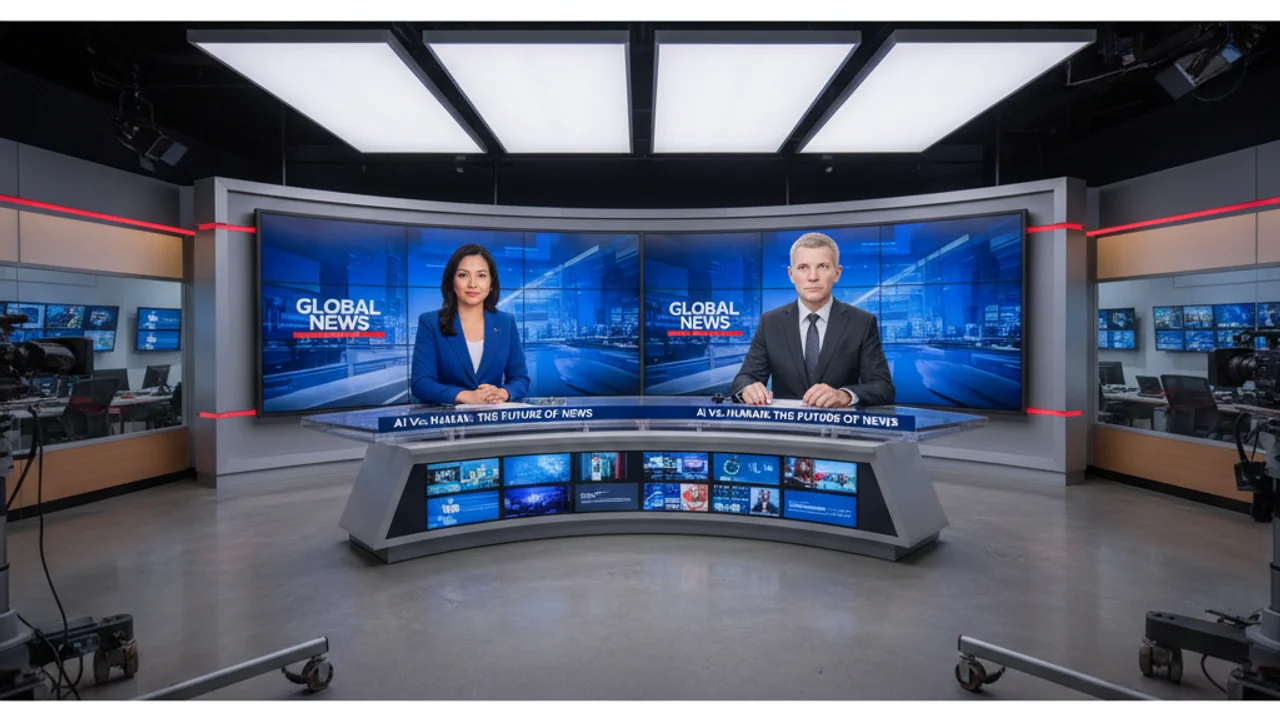
A polished news segment appears in your social media feed. A professional-looking anchor sits behind a studio desk, complete with lower-third graphics, a network-style logo, and the visual language of broadcast journalism you have seen your entire life. The anchor reports breaking news about a major corporate scandal, a geopolitical crisis, or a public health warning. The segment looks entirely legitimate. But the anchor does not exist. The studio does not exist. And the story is fabricated from the first word to the last.
AI-generated news anchors represent one of the most sophisticated forms of disinformation to emerge in recent years. By replicating the trusted format of television news, these synthetic broadcasts exploit decades of conditioned trust in the visual language of journalism. Understanding how they work, who creates them, and how to identify them is critical for anyone who consumes news through digital channels.
The Rise of the Synthetic Newsroom
The concept of AI-generated presenters started in legitimate contexts. Several Asian news agencies began experimenting with disclosed AI anchors for routine content like weather updates and financial summaries as early as 2023. These applications were transparent about the synthetic nature of the presenter and served practical purposes such as 24/7 content generation without human fatigue.
The malicious adaptation was predictable. If you can generate a convincing news anchor delivering legitimate weather reports, the same technology can generate a convincing anchor delivering completely fabricated stories. Criminal organizations and state-sponsored influence operations quickly recognized the potential. By 2025, researchers had identified dozens of fake news channels operating entirely with AI-generated presenters, producing content in multiple languages and distributing it across social media platforms worldwide.
What makes this particularly dangerous is the scalability. A traditional disinformation operation involving real people is expensive, risky, and limited by the availability of willing participants. A synthetic newsroom can generate unlimited content around the clock, in any language, at negligible marginal cost. The economics of disinformation have fundamentally shifted.
How Fake News Broadcasts Are Made
Creating a convincing fake news broadcast involves several layered technologies. The anchor's face and body are generated using the same type of AI systems that power face-generation research, producing a photorealistic human who has never existed. The voice is synthesized using text-to-speech models trained to mimic the cadence, tone, and delivery style of real news anchors. Lip synchronization technology matches the generated mouth movements to the synthesized speech.
The production wrapper is equally important. Operators create studio backgrounds, lower- third graphics, ticker scrolls, and network logos that mimic the visual conventions of real broadcast news. Some operations even fabricate entire fictional news networks with websites, social media profiles, and content archives to establish apparent legitimacy. The presentation is designed so that someone encountering a single clip on social media would have no immediate reason to question its origin.
Spotted a suspicious news clip on social media? Scan it instantly for AI manipulation.
State-Sponsored Disinformation at Scale
Research teams at major universities and think tanks have documented state-sponsored operations using AI-generated news anchors to push geopolitical narratives. These operations produce content targeting foreign audiences in their native languages, spreading narratives that align with the sponsoring state's strategic interests. The content ranges from subtle framing of real events to outright fabrication of incidents that never occurred.
The sophistication of these operations extends beyond the video content itself. They are supported by networks of fake social media accounts that share and amplify the content, SEO-optimized websites that host the clips alongside other seemingly legitimate articles, and coordinated timing that aligns content releases with real-world events to maximize plausibility. This creates an ecosystem where the synthetic news clip is encountered within a context designed to make it look credible.
The intersection with political deepfake operations is particularly concerning. A synthetic news broadcast can be used to "report" on a deepfake video of a politician, creating a layered deception where the fake news segment lends credibility to the fake political footage and vice versa. This multi-layered approach makes the disinformation significantly harder to debunk because each fabricated element appears to be independently corroborated.
Related reading: How to Spot a Deepfake Video: Visual and audio detection techniques you can use right now
Distribution Through Social Media
Fake news broadcasts are specifically formatted for social media distribution. Clips are cut to 30 to 90 seconds, the optimal length for engagement on platforms like TikTok, Instagram Reels, and YouTube Shorts. They include attention-grabbing headlines overlaid on the video and are uploaded with keyword-rich descriptions designed to surface in platform search and recommendation algorithms.
The distribution strategy often targets specific demographic and interest groups through platform advertising tools or coordinated sharing in relevant community groups. A fake health news segment might be distributed through wellness groups on Facebook. A fabricated financial news clip might appear in investing communities on Reddit. The targeting ensures that the content reaches audiences predisposed to be interested in and influenced by its narrative, much like the targeted approach used in celebrity deepfake investment scams .
Visual Tells of AI-Generated Anchors
Despite their sophistication, AI-generated news anchors still exhibit telltale signs that distinguish them from real people. The most consistent tell is limited expressional range. Real news anchors exhibit subtle micro-expressions: slight eyebrow raises for emphasis, barely perceptible frowns during serious stories, natural shifts in posture. AI-generated anchors tend to have a more uniform, controlled expression that lacks these micro-level variations.
Movement patterns are another indicator. Real people shift in their seats, adjust their posture, gesture naturally, and occasionally look away from the camera. Synthetic anchors typically maintain an unnaturally consistent posture, with head movements that feel slightly mechanical and repetitive. The hands are often hidden or kept still because natural hand gestures remain difficult for generation models to produce convincingly.
The voice provides additional clues. While AI voice synthesis has improved dramatically, listen for a slightly flat tonal quality that lacks the natural prosodic variation of human speech. Real anchors adjust their tone, pace, and emphasis based on emotional context. AI voices often maintain a more uniform delivery, particularly during transitions between different emotional registers such as moving from a tragic story to a lighter human interest segment. For detailed visual detection techniques, see our comprehensive deepfake spotting guide .
Which of the following is the most reliable visual indicator of an AI-generated news anchor?
- The anchor reads from a teleprompter
- Limited micro-expressions and unnaturally uniform posture
- The broadcast uses lower-third graphics
- The anchor wears professional attire
Answer: AI-generated anchors consistently lack the subtle micro-expressions, natural posture shifts, and spontaneous gestures that real humans exhibit. Professional attire, teleprompter use, and graphics are normal elements of any broadcast.

Legitimate AI Presenters vs. Malicious Fakes
Not all AI-generated presenters are malicious. The key distinction is disclosure and intent. Legitimate uses clearly label the presenter as AI-generated, operate under the editorial standards of recognized news organizations, and serve practical purposes like extending coverage hours or creating accessible content in multiple languages. Malicious uses are undisclosed, operate outside any editorial framework, and are designed to deceive viewers into believing they are watching real journalism reporting real events.
When evaluating a news clip, check whether the broadcasting entity exists as a recognized news organization. Search for the network name, the anchor's name, and the specific story being reported. If the clip exists only on social media with no corresponding coverage from any established news outlet, it should be treated with extreme suspicion regardless of how professional it looks.
Related reading: AI Content Detection Methods: Tools and techniques for identifying AI-generated media
Protecting Yourself From Synthetic News
The most effective defense against synthetic news content is a multi-source verification habit. Before believing or sharing any news clip encountered on social media, check whether the same story is being reported by multiple established, independent news organizations. If a supposedly major story appears only in a single social media clip, it is almost certainly fabricated.
Use Truvizy's free video analysis tool to scan suspicious news clips. The AI-powered detection system analyzes the video for generation artifacts, facial consistency, audio-visual synchronization, and other signals that distinguish synthetic content from camera-captured footage. A few seconds of analysis can prevent you from sharing disinformation to your entire social network.
Need systematic synthetic media monitoring for your organization?
For media organizations, fact-checking teams, and researchers who encounter synthetic news content regularly, Truvizy's professional plans offer the volume, forensic detail, and documentation capabilities needed for systematic synthetic media monitoring. In an era where entire newsrooms can be fabricated at the click of a button, the ability to rapidly and reliably verify media authenticity is not a luxury. It is a necessity for any organization that values truth.
Key Takeaways
- AI-generated news anchors replicate the trusted format of broadcast journalism to spread disinformation at scale.
- State-sponsored operations use synthetic newsrooms to target audiences across multiple continents and languages.
- Look for limited micro-expressions, unnaturally still hands, and flat vocal delivery to spot synthetic anchors.
- Always verify news clips through multiple established sources before believing or sharing them.
Related reading: The Dangers of Synthetic Media: How AI-generated content is reshaping trust in digital media
Frequently Asked Questions
What are AI-generated news anchors?
AI-generated news anchors are fully synthetic video personas created using generative AI. They feature computer-generated faces, AI-synthesized voices, and scripted dialogue designed to mimic the appearance and delivery of real television news presenters.
How are fake AI news broadcasts used for disinformation?
They are used to fabricate entire news segments that present false narratives with the visual authority of professional journalism. These clips spread on social media and messaging apps, where viewers may assume they are legitimate broadcast content.
Can AI news anchors be used for legitimate purposes?
Yes. Some legitimate news organizations use disclosed AI presenters for routine updates like weather and traffic. The concern is specifically about undisclosed synthetic presenters used to spread false information while impersonating real journalism.
How can I tell if a news clip features an AI anchor?
Look for unnaturally smooth facial movements, limited range of expressions, a voice with flat tonal variation, and the absence of the news segment on any established network's official channels. AI detection tools can also analyze the video for synthetic generation artifacts.
Which countries have been targeted by fake AI news operations?
Documented operations have targeted audiences in the United States, Europe, Africa, and Southeast Asia. The content is often produced in multiple languages to maximize reach across different regions.