Social Engineering Attacks: How Scammers Manipulate You Into Trusting Them
Understand the psychology behind social engineering attacks. Learn how scammers use authority, urgency, fear, and trust to manipulate victims, and how to recognize and resist these tactics.
· By Truvizy Research Team · 8 min read
TL;DR
Social engineering exploits human psychology rather than technical vulnerabilities. Scammers use six core manipulation techniques, authority, urgency, scarcity, social proof, reciprocity, and emotional hijacking, to override your critical thinking. Recognizing these patterns is the first step to immunity, and AI-powered tools can catch the attacks you miss.

The most sophisticated cyberattack in the world does not require a single line of code. It requires a phone call, a convincing story, and a victim who does not realize they are being manipulated until it is too late. Social engineering, the art of exploiting human psychology to gain access, information, or money, is responsible for the vast majority of successful cyberattacks. IBM's 2025 security report found that human-targeted attacks accounted for over 90 percent of data breaches, dwarfing all technical vulnerabilities combined.
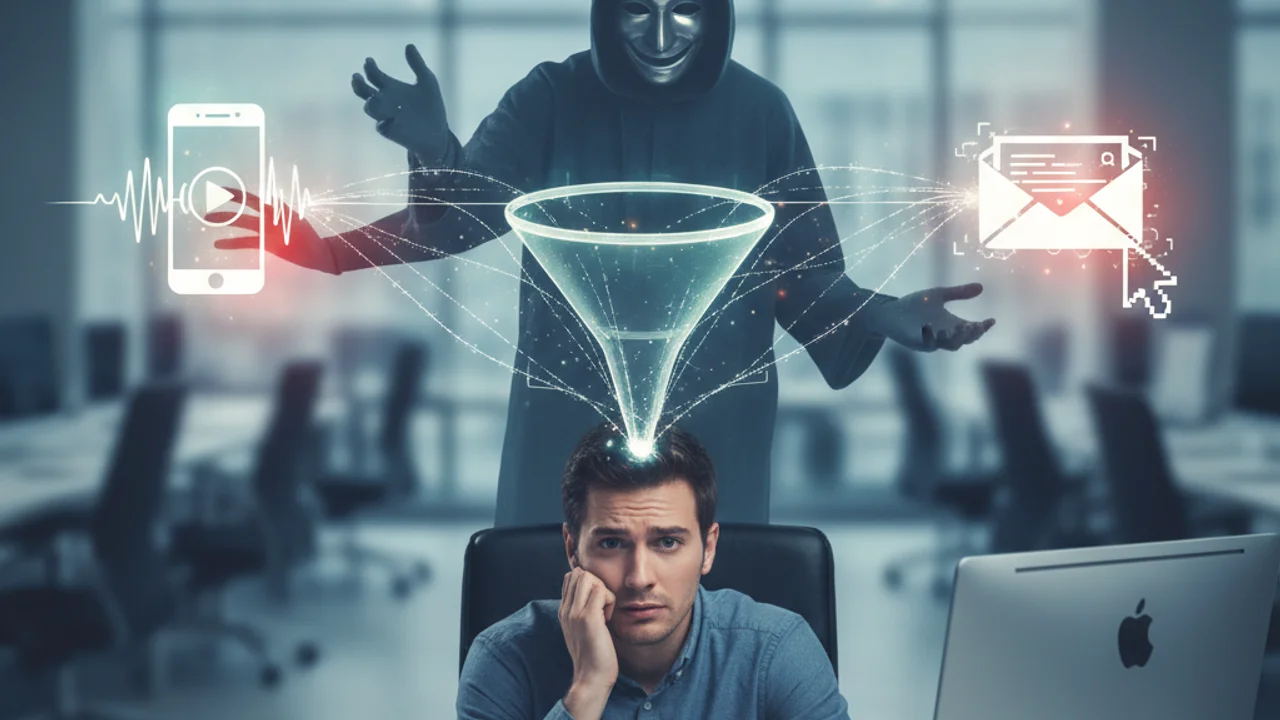
What makes social engineering so effective is that it does not attack your computer. It attacks you. It targets the cognitive shortcuts your brain uses to make quick decisions: trusting authority figures, responding to urgency, following social norms, and reciprocating kindness. These mental shortcuts served humans well for millennia, but in a digital environment saturated with AI-generated deception, they have become critical vulnerabilities. Understanding how these attacks work is the first and most important step toward immunity.
What Is Social Engineering and Why It Works
Social engineering is psychological manipulation designed to make you take an action that serves the attacker's interests while appearing to serve yours. The term encompasses a wide range of tactics, from mass phishing emails to highly targeted, researched attacks known as spear phishing, from impersonated phone calls to deepfake video conferences. What unites all these techniques is their reliance on human behavior rather than technical exploitation.
The fundamental reason social engineering works is that human decision-making operates on two tracks. The fast track, which psychologists call System 1 thinking, handles routine decisions automatically using heuristics and emotional cues. The slow track, System 2, is deliberate and analytical. Social engineering attacks are specifically designed to engage System 1 and prevent System 2 from activating. They create scenarios where acting quickly feels right and pausing to think feels risky.
Authority: Impersonating People You Trust
The most common social engineering tactic is authority impersonation. Scammers pose as bank representatives, government officials, tech support agents, company executives, or law enforcement officers, leveraging the automatic deference most people show to perceived authority figures. When someone identifies themselves as calling from your bank about a security issue, your instinct is to cooperate, not to question whether they are who they claim to be.
In the AI era, authority impersonation has reached new levels of sophistication. Voice cloning can replicate a CEO's voice for a fraudulent phone call to the finance department. Deepfake video can create a convincing virtual meeting with executives who are not actually present. Even simple techniques like spoofing caller ID to display a bank's real phone number or creating email addresses that differ from the real one by a single character remain devastatingly effective.
The defense is simple in principle but requires discipline: always verify identity through an independent channel. If your bank calls, hang up and call the number on the back of your card. If your boss emails an unusual request, verify by phone or in person. This independent verification habit is the single most protective behavior you can develop. For specific techniques to verify suspicious video content, see our complete video verification guide .
Urgency and Fear: Short-Circuiting Critical Thinking
Almost every social engineering attack includes a time pressure component. "Your account will be locked in 30 minutes." "This offer expires today." "You must act now or face legal consequences." Urgency works because it activates the brain's threat response system, flooding you with stress hormones that narrow focus and suppress analytical thinking. Under genuine time pressure, people make faster decisions with less information, exactly what the attacker needs.
Fear amplifies the effect. Threats of arrest, account closure, financial loss, or public embarrassment activate the same stress response while adding the additional burden of emotional distress. The victim's cognitive resources are consumed by managing their fear rather than evaluating the legitimacy of the threat. This is why IRS impersonation scams, which threaten arrest for unpaid taxes, remain effective year after year despite widespread awareness campaigns.
Received a threatening message demanding immediate action? Scan it with Truvizy before responding.
Social Proof and Scarcity: Manufacturing Consensus
Humans are fundamentally social creatures who look to others for guidance on how to behave, especially in unfamiliar situations. Scammers exploit this through manufactured social proof: fake reviews, fabricated testimonials, bot-generated engagement, and paid influencer endorsements for fraudulent products. When you see thousands of positive reviews for a product or hundreds of enthusiastic comments on an investment opportunity, your brain interprets that volume as evidence of legitimacy.
Scarcity, the perception that something is limited or running out, creates additional pressure. "Only 3 left at this price." "Limited to the first 100 investors." "This exclusive group closes tomorrow." Scarcity triggers loss aversion, our disproportionate fear of missing out, which is psychologically more powerful than the prospect of equivalent gain. Combined with social proof showing that others are already taking action, scarcity creates a powerful urge to act immediately without proper due diligence.
Reciprocity and Rapport: The Gift That Takes
Reciprocity is one of the strongest social norms across cultures: when someone does something for you, you feel obligated to return the favor. Social engineers exploit this by offering something of apparent value before making their request. A scammer might provide free investment advice, solve a fabricated tech problem, or share seemingly insider information, all to create a sense of obligation that makes you more likely to comply with what comes next.
Romance scams are perhaps the most devastating application of rapport-based engineering. Scammers invest weeks or months building genuine-feeling emotional connections with their victims, providing companionship, emotional support, and apparent vulnerability. By the time the financial request arrives, the victim feels they are helping a loved one, not sending money to a stranger. The vulnerability of older adults to these relationship-based scams makes family awareness and communication especially important.
AI-Powered Social Engineering: The New Frontier
Artificial intelligence has transformed social engineering from a craft practiced by skilled con artists into an industrial-scale operation accessible to anyone. Large language models can generate personalized phishing emails at volume, each one tailored to the recipient's interests, writing style, and social context. Voice cloning technology requires only a few seconds of audio to create a convincing replica of any voice. Real-time deepfake video can impersonate colleagues during video calls.
The scale is particularly alarming. Where a human scammer might craft a dozen convincing phishing emails per day, AI can generate thousands per hour, each uniquely personalized. Translation models allow attackers to target victims in any language without fluency. And the quality continues to improve: AI-generated phishing emails now consistently outperform human-written ones in click-through rates during security testing exercises.
You receive an unexpected email from your 'boss' urgently requesting a wire transfer. The email looks legitimate. What is the BEST response?
- Complete the transfer quickly since it is urgent
- Reply to the email asking for more details
- Verify by calling your boss directly on their known phone number
- Forward the email to IT and wait for their response
Answer: Always verify unusual requests through an independent channel. Replying to the email would go back to the attacker. Calling your boss directly on their known number confirms whether the request is real.
Building Your Resistance to Manipulation
The core defense against social engineering is developing what security professionals call a "healthy paranoia" about unsolicited contact. This does not mean living in fear. It means building a simple habit: whenever you receive an unexpected request, whether by phone, email, text, social media, or video call, pause before responding and ask three questions. First, did I initiate this contact? Second, is there time pressure or emotional pressure being applied? Third, can I verify this through an independent channel?
If the answer to the first question is no, the second is yes, and the third is "I have not tried yet," you are almost certainly looking at a social engineering attempt. The pause itself is the most valuable defense because it shifts your brain from System 1 (fast, automatic) to System 2 (slow, analytical) thinking. Scammers know that the longer you think, the less likely you are to comply, which is precisely why they create urgency.

Tools and Defenses That Catch What You Miss
Even with strong awareness, everyone has moments of vulnerability. Stress, fatigue, distraction, or a particularly well-crafted attack can slip past your defenses. This is where automated detection tools provide a critical safety net. Truvizy's scanning platform analyzes suspicious videos and content for manipulation signals that are invisible to the human eye, catching deepfake impersonation, fabricated endorsements, and deceptive patterns that social engineers rely on.
Key Takeaways
- Pause before acting on any unexpected request with urgency or emotional pressure.
- Always verify identity through an independent channel, never trust the contact method the requester provided.
- AI has made social engineering industrial-scale: thousands of personalized attacks per hour.
- Layer defense with 2FA, password managers, and AI-powered detection tools to catch what you miss.
Combine detection tools with strong authentication practices. Enable two-factor authentication on every account so that even if a social engineering attack extracts your password, the attacker still cannot access your account. Use a password manager to eliminate password reuse, removing the cascading effect of a single compromised credential. And for comprehensive family protection, Truvizy's plans provide AI-powered scanning that acts as a shared safety net for everyone you care about.
The arms race between social engineers and defenders will continue to escalate. But the fundamental defense remains the same: slow down, verify independently, and use tools that see what you cannot. Build these habits now, and you will be far better prepared for whatever manipulation techniques emerge next.
Social engineering attacks are getting smarter, stay ahead with AI-powered protection.
Related reading: Phishing Email Detection Guide: Spot and stop phishing attacks before they succeed
Related reading: How to Spot Deepfake Videos: Detect AI-generated video manipulation
Related reading: Identity Theft Prevention: 15 steps to protect your personal information
Frequently Asked Questions
What exactly is social engineering in cybersecurity?
Social engineering is the manipulation of people into performing actions or divulging confidential information. Unlike hacking, which exploits software vulnerabilities, social engineering exploits human psychology, trust, fear, helpfulness, and authority compliance, to bypass security measures.
Why do smart people fall for social engineering?
Intelligence does not protect against social engineering because these attacks target emotional and instinctive responses, not logical reasoning. The urgency, fear, or authority cues trigger fast, automatic thinking that bypasses analytical processes. Anyone can be caught in the right circumstances.
What are the most common types of social engineering attacks?
The most prevalent types include phishing emails, pretexting (creating a false scenario), baiting (offering something enticing), tailgating (following someone into a restricted area), vishing (voice phishing by phone), and AI-powered impersonation using deepfake video or cloned voices.
How has AI made social engineering more dangerous?
AI enables voice cloning from seconds of audio, convincing deepfake video calls, personalized phishing messages generated at scale, and real-time language translation that allows attackers to target victims in any language. These tools have dramatically lowered the skill barrier for sophisticated attacks.
How can I train myself to resist social engineering?
Build a habit of pausing before acting on any request that creates urgency or emotional pressure. Verify identities through independent channels. Be skeptical of unsolicited contact, even from familiar names. Use AI-powered detection tools to verify suspicious content, and share your knowledge with family and friends.